

The Defensive Line Weekly is a curated weekly intelligence briefing for blue teamers and security leaders, researched and written by humans with AI assistance used to support drafting and editing.
Overview
The standout attack this week was the ShinyHunters compromise of Oracle PeopleSoft instances via a zero-day. With no patch available, it is unsurprising that the campaign affected a large number of organisations. It is worth asking what defence-in-depth could have achieved here, given the attackers needed only reach to the web service to obtain sensitive data.
Elsewhere this week, supply chain compromises continued, AI agents again proved difficult to secure, and ransomware groups proliferated further.
Contents
ShinyHunters burns an Oracle PeopleSoft zero-day — a CVSS 9.8 remote code execution flaw (CVE-2026-35273) exploited before Oracle’s advisory; 100+ organisations notified, higher education hit hardest.
The software supply chain under siege — 400+ Arch Linux AUR packages hijacked to drop a credential stealer and eBPF rootkit, as GitHub moves to switch off npm install scripts by default.
AI agents become the attack surface — remote code execution in LangGraph and Langflow, plus “Agentjacking” and OpenClaw abuse that turn helpful agents into code-execution paths.
The Gentlemen ransomware — now 478 claimed victims (up from 320 in April) and worm-like spread, from a group that has graduated from RaaS affiliate to operator.
Vulnerability Roundup
Vendor Watch
Article 1: ShinyHunters exploits an Oracle PeopleSoft zero-day (CVE-2026-35273)
Summary
Google’s Mandiant and Threat Intelligence Group (GTIG) reported that the financially motivated extortion group ShinyHunters — which GTIG tracks as UNC6240 — exploited a critical flaw in Oracle PeopleSoft, the widely deployed enterprise resource planning (ERP) suite, between 27th May and 9th June 2026. The vulnerability — CVE-2026-35273, CVSS 9.8 — is a remote code execution (RCE) bug in the PeopleSoft Environment Management component, used against internet-facing Environment Management Hub (PSEMHUB) endpoints. Because the activity pre-dated Oracle’s out-of-band security alert on 10th June, it was exploited as a zero-day.
GTIG notified more than 100 organisations whose endpoints correlated with potentially vulnerable infrastructure. Most were US-based, and 68% were in the higher education sector. The Record reported that the University of Nottingham confirmed a cyber incident and began contacting affected students and alumni, potentially including those at its campuses in Malaysia and China. According to the responders, the attackers staged customised MeshCentral remote-management agents disguised as legitimate cloud endpoints, and deployed a custom lateral-movement and defacement script; open attacker directories left on staging servers allowed GTIG to triage the operation. Palo Alto Networks’ Unit 42 is tracking related activity as “Bling Libra”.
Analysis
This is a textbook edge-exposure story: an unauthenticated RCE in an internet-facing enterprise application, weaponised before a patch existed and aimed at a sector that tends to run large, federated and under-resourced estates. It is also the second time in six weeks that ShinyHunters has been seen squarely targeting education: in early May the group breached Canvas through Instructure’s free-educator programme, claiming records on hundreds of millions of students. The shift from SaaS-platform abuse to an unauthenticated ERP zero-day suggests the same actor is broadening its technique set while staying fixed on a sector it clearly views as soft. The heavy higher-education skew this week points to opportunistic targeting of exposed PSEMHUB endpoints rather than bespoke victim selection.
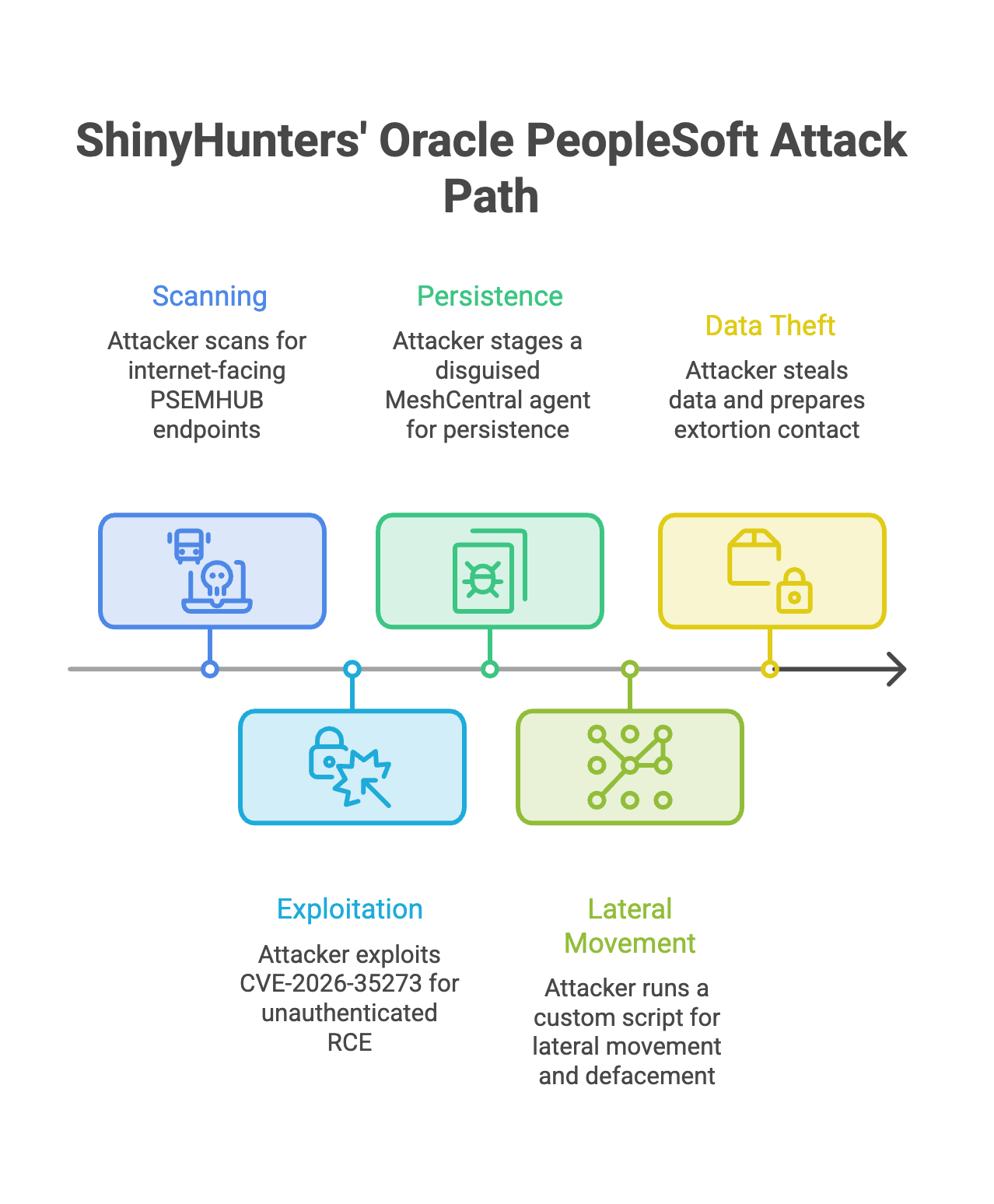
The use of a legitimate remote-management tool (MeshCentral) for persistence is consistent with the group’s preference for blending into normal administrative activity, which makes detection harder for teams that do not baseline their remote-access tooling. Given ShinyHunters’ established extortion model, affected organisations should assume data theft and prepare for extortion contact rather than treating this as a contained intrusion; with mean time-to-exploit now measured in days, any internet-facing PeopleSoft estate that was unpatched on 10th June should be treated as potentially in scope.
Defensive actions
Patch & exposure
Oracle released its fix on 10th June (PeopleTools 8.61 and 8.62 are affected): prioritise patching CVE-2026-35273, and inventory all PeopleSoft instances to confirm which are internet-facing.
Consider removing PSEMHUB / Environment Management Hub endpoints from direct internet exposure, placing them behind a VPN or an access proxy.
Remote-management tooling
Where MeshCentral and similar RMM tools have no legitimate business use, consider blocking them by publisher certificate using application control (WDAC or AppLocker) — this removes the persistence path rather than relying on spotting it after the fact.
Identity & data
Where exposure is confirmed, consider rotating credentials and service-account secrets reachable from compromised hosts, and ready breach-notification and extortion-response playbooks.
For organisations with security operations capability
Baseline approved remote-access tooling and hunt for unsanctioned MeshCentral agents — an RMM tool running where it shouldn’t exist is a strong indicator of compromise — and review web and application logs on PeopleSoft hosts for anomalous process execution. This is reactive investigation; it assumes the staffing and tooling to triage the results.
Sources: Oracle Security Alert (CVE-2026-35273), Google Cloud / Mandiant (GTIG), Rapid7, Dark Reading, The Record
Article 2: The software supply chain under siege — Arch AUR hijack and GitHub’s npm clamp-down
Summary
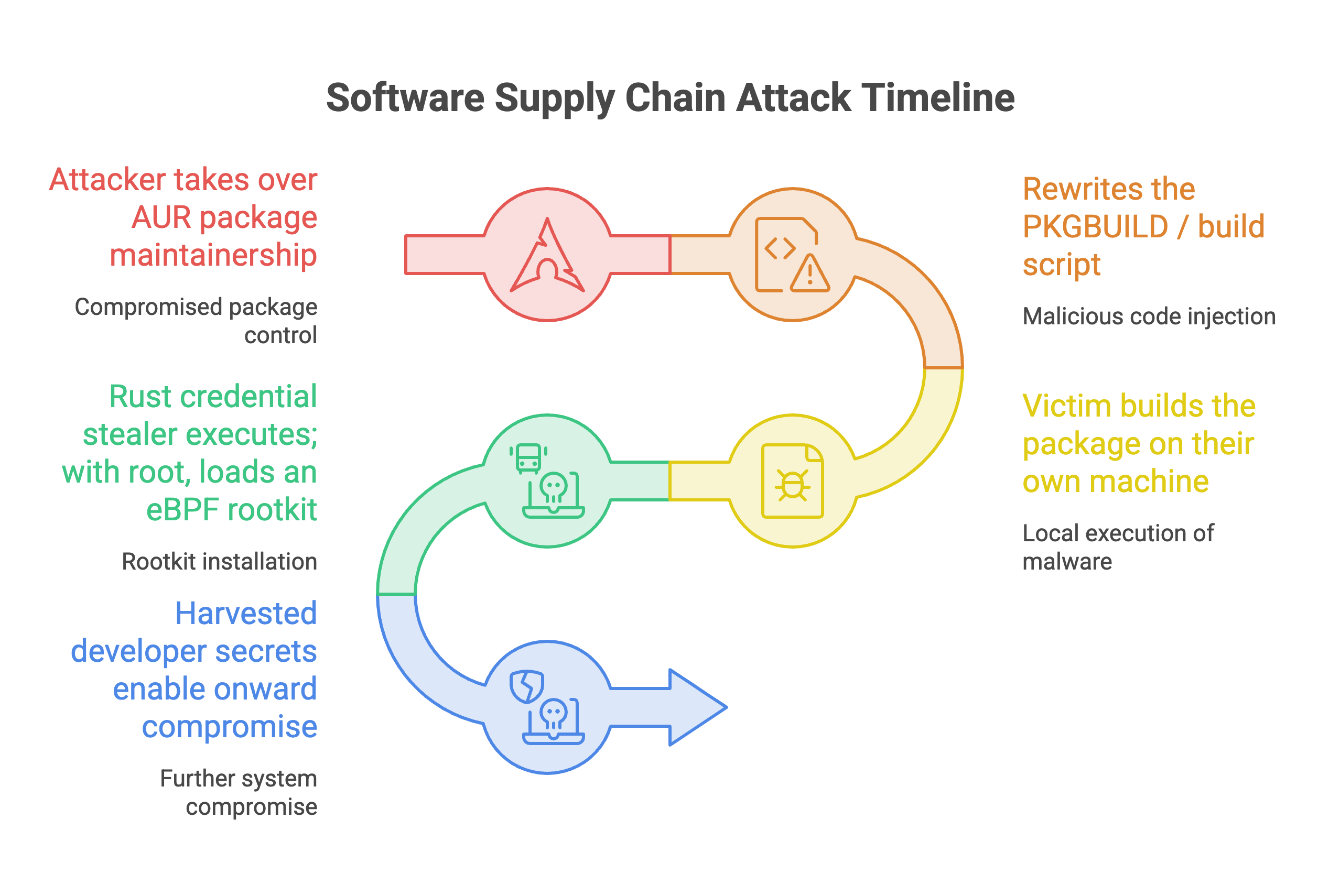
The Hacker News reported that attackers took over more than 400 packages in the Arch User Repository (AUR) — Arch Linux’s community-maintained package collection, which is separate from the official repositories — and rewrote their build scripts so that any machine building them installed a credential stealer (a Rust binary built to harvest developer secrets that, with root, can load an eBPF rootkit to hide itself). In the same week, GitHub, which operates npm, announced that npm version 12 will disable install scripts by default — directly targeting the lifecycle-hook abuse (automatic code execution during npm install) that has powered a long run of npm supply-chain attacks.
Analysis
The through-line is that the developer’s build environment is now a primary target, not an afterthought. The AUR compromise exploits a trust model where users routinely build community packages on their own machines, and the addition of an eBPF rootkit raises the stealth ceiling well beyond a typical stealer. This also lands at the end of a sustained run of registry and build-pipeline attacks we’ve tracked week after week — most recently last week’s Miasma/Shai-Hulud worm across npm, PyPI and GitHub. The mechanism rhymes each time: compromise a trusted namespace or build path, harvest the credentials it can reach, then propagate.
GitHub’s npm change is structurally significant — turning off install scripts removes one of the most reliable execution primitives attackers rely on — but it will break legitimate workflows that depend on post-install steps, so expect friction and exceptions that erode the benefit if not managed centrally. It also does nothing against the other half of this pattern: malicious code that runs at import or build time rather than on install. That is why a registry-proxy minimum release age — rejecting versions published in the last few days, so the community can spot and pull malicious releases first — remains one of the most practical complementary controls. Neither change helps teams that have no inventory of what their build pipelines actually fetch and execute.
Defensive actions
Build & developer environments
Treat AUR and other community repositories as untrusted; where feasible, build packages in ephemeral, sandboxed environments rather than on developer or production hosts.
Review PKGBUILD / build scripts before building, and pin known-good versions.
Package hygiene
Adopt
--ignore-scriptsnow and prepare pipelines for npm v12’s default change; maintain lockfile integrity and dependency pinning.Consider enforcing a minimum release age on your registry proxy (a common baseline is 3 days for general dependencies, 7 for production-critical packages), with a documented override path so genuine emergency patches aren’t blocked.
Where machines may have built affected packages, rotate developer credentials and npm/CI/CD tokens that could have been exposed.
For organisations with security operations capability
Hunt for unexpected root-level binaries and eBPF-based hiding techniques on developer endpoints and build agents.
Sources: The Hacker News (Arch AUR), The Hacker News (GitHub / npm)
Article 3: AI agents become the attack surface — LangGraph, Langflow, Agentjacking and OpenClaw
Summary
A cluster of disclosures showed AI agent tooling becoming a direct route to code execution. Check Point Research detailed a chain in LangGraph — an open-source framework (an extension of LangChain) for building stateful, multi-agent systems — in which its checkpointer persistence layer could be taken from SQL injection to remote code execution. Field Effect warned that a flaw in Langflow, a popular visual builder for AI workflows, was under active exploitation with no patch available as of June 2026: an arbitrary file-write that can lead to full RCE, with thousands of instances publicly exposed and a public proof-of-concept lowering the barrier to entry.
Separately, Tenet Security described “Agentjacking”, a new class of attack that tricks AI coding agents into running arbitrary code on developer machines via a booby-trapped error report crafted in Sentry (an error-tracking platform). And Imperva and Varonis independently showed OpenClaw — a popular self-hosted personal AI agent — being driven to execute attacker code or hand over secrets through ordinary-looking inputs such as shared contacts, vCards and location pins that the agent processes without the victim ever seeing them.
Analysis
These are different bugs with one shared root cause: AI agents combine privileged access to data, exposure to untrusted input, and the ability to take actions — the “lethal trifecta” — so a single malicious input can become code execution. This is now a standing theme rather than a novelty; we’ve tracked AI tooling becoming an attack surface across recent editions, including last week’s abuse of Meta’s AI support bot. Langflow in particular is not new to these pages — a separate unauthenticated RCE (CVE-2026-33017) featured in our The Defensive Line Weekly #13 (15–22 March 2026) — and the recurrence underlines how quickly these fast-moving projects accrue serious, sometimes unpatched, flaws.
Self-hosted deployments are especially exposed because teams stand them up quickly, often on internet-reachable infrastructure, without treating them as production attack surface. The Langflow case is the most urgent: active exploitation, no patch, and a public PoC. Taken together, the Agentjacking and OpenClaw work is a strong signal that agent inputs — issues, tickets, contacts, calendar invites, error reports — must now be treated as untrusted code paths, not passive data the agent merely reads.
Defensive actions
Exposure
Inventory self-hosted AI agent frameworks (LangGraph, Langflow, OpenClaw and similar) and ensure none are directly internet-facing.
For Langflow specifically (no patch yet): restrict or remove network access to the vulnerable endpoint, and disable file upload where possible.
Hardening & identity
Run agents in sandboxes or containers with least-privilege tokens and no standing access to production secrets.
Treat all agent inputs (vCards, contacts, location pins, error reports, tickets) as untrusted; constrain tool execution and consider requiring human approval for sensitive actions.
For organisations with security operations capability
Monitor agent runtimes for unexpected child processes, outbound connections and secret access.
Sources: Check Point Research (LangGraph), Field Effect (Langflow), The Hacker News (Agentjacking), The Hacker News (OpenClaw)
Article 4: The Gentlemen ransomware — 478 victims and worm-like spread
Summary
We first covered The Gentlemen in April, when Check Point Research profiled a fast-growing ransomware-as-a-service (RaaS) operation with around 320 claimed victims. What’s changed since then: new analysis from threat-intelligence firm PRODAFT — which tracks the group as Phantom Mantis (aka ArmCorp) — puts it at 478 claimed victims, documents worm-like self-propagation, and traces its maturation from an affiliate into a standalone operator, as reported by The Hacker News. According to the research, the group initially ran double-extortion attacks while drawing on resources from established RaaS schemes — LockBit (aka Tenacious Mantis), Qilin (aka Pestilent Mantis) and Medusa (aka Venomous Mantis) — before building its own operation.
Analysis
The worm-like propagation is the part defenders should weigh most heavily: self-spreading capability turns a single foothold into estate-wide impact and compresses response time to the point where containment has to be automatic rather than analyst-driven. The jump from 320 to 478 claimed victims in roughly eight weeks also tells its own story — this is not a niche operator but one of the more active groups in the landscape right now, so it belongs in most organisations’ threat models.
The affiliate-to-operator trajectory illustrates how RaaS lowers the barrier for a capable affiliate to graduate into a standalone brand, reusing tooling and tradecraft from multiple schemes rather than building from scratch. The double-extortion model also means backups alone are not a complete answer: restoring encrypted systems does nothing about stolen data, which still gives the group extortion leverage. Defence here is squarely about limiting blast radius and ensuring recovery is tested, not just present.
Defensive actions
Segmentation & lateral movement
Segmentation is high-impact but genuinely hard to deliver, so rather than attempt a wholesale redesign, target the worm’s path with one or two concrete choke points: block SMB and administrative protocols (RDP, WMI, RPC) between workstations so a single foothold can’t fan out peer-to-peer, and ensure ordinary workstations can’t reach domain controllers, backup infrastructure or finance systems without stepping through a jump host.
Identity
Consider phishing-resistant MFA and separate, tiered administrative accounts with just-in-time elevation to slow privilege escalation.
Endpoint (defence in depth)
Ensure EDR is deployed with tamper protection enabled, treating it as one layer that shortens dwell time — not a standalone answer to worm-like spread.
Backup & recovery
Keep at least one backup copy beyond the reach of a compromised admin: immutable (time-locked retention), offline/air-gapped, or in a separate account/tenant with distinct credentials and MFA — so a single compromised domain or cloud admin cannot encrypt or delete every copy in one session.
Test restoration rather than just confirming backups exist: work up a ladder (tabletop → single-system restore → full-service restore) into an isolated environment, and validate that the service actually works — identity, certificates, secrets and integrations — not just that the data came back. Record time-to-usable-service against your RTO.
Treat double extortion as a separate problem from encryption: restoring systems does nothing about stolen data, so pair recovery with breach-notification and extortion-response planning.
For organisations with security operations capability
Alert on mass file operations and rapid, scripted deployment behaviour across multiple hosts.
Sources: PRODAFT — Inside the Phantom Mantis Operation, The Hacker News
Honourable mentions
Velvet Ant hides in the Linux login stack — Sygnia says the China-nexus group spent close to a decade hidden inside the PAM and OpenSSH components that decide who can sign in, planting access where routine clean-up could not reach. Sources: The Hacker News
APT28 evolves its tradecraft — Sekoia‘s TDR team details new tooling and techniques from APT28 (aka Fancy Bear / Forest Blizzard), publicly attributed to Russia’s GRU Unit 26165 — a group we’ve tracked repeatedly, most recently its SOHO-router DNS-hijacking campaign. Sources: Sekoia
Great Marlow School closed by cyberattack — the 1,428-pupil school sent students home while specialist IT and cybersecurity teams work to recover. Sources: The Record
Plymouth City Council email gaffe — a mass email to home-schooling families exposed recipients’ addresses, prompting an ICO report and an apology. Sources: The Register
Novo Nordisk reports a cyberattack — clinical-trial participant data was stolen, though the company says the exposed records were pseudonymised. Sources: The Register
Google sues a Chinese smishing network — Google is pursuing a network it accuses of weaponising its Gemini AI to run a phishing-as-a-service kit (”Outsider”) targeting Americans. Sources: The Hacker News
Vulnerability Roundup
Act now (0–72h)
Splunk / Splunk Enterprise — CVE-2026-20253 — Critical (CVSS 9.8) — Patch available, public exploit — per Splunk’s advisory (SVD-2026-0603), an unauthenticated PostgreSQL sidecar service endpoint lets an attacker create or truncate arbitrary files, which can lead to remote code execution. Do: upgrade to 10.4.0, 10.2.4 or 10.0.7 (or later) and restrict management-plane access. Sources: Splunk SVD-2026-0603, The Hacker News
Ivanti / Ivanti Sentry — CVE-2026-10520 (CVSS 10, OS command injection) & CVE-2026-10523 (CVSS 9, authentication bypass) — Exploited in the wild within 24h of disclosure — the flaws let an unauthenticated, remote attacker reach root-level code execution or create arbitrary administrative accounts on the Sentry gateway; attackers appear to have pre-mapped Ivanti’s asset landscape and moved as soon as the exploit was public. This is a distinct product from the Ivanti EPMM flaws exploited earlier this year. CISA added CVE-2026-10520 to its Known Exploited Vulnerabilities catalogue on 11th June. Do: apply Ivanti’s fix (R10.5.2 / R10.6.2 / R10.7.1) immediately and review external exposure; for teams with security operations capability, hunt for post-exploitation activity. Sources: Ivanti Security Advisory, Dark Reading
Watchlist (this week)
Microsoft / Windows BitLocker — “GreatXML” bypass (researcher: Nightmare Eclipse) — Public PoC, local/physical access — the proof-of-concept abuses Microsoft Defender’s offline-scan handling of recovery-partition XML files to spawn a SYSTEM shell in Recovery Mode. Practicality is disputed: as The Hacker News notes, researcher Will Dormann argues the documented steps require a logged-in admin (at which point disabling BitLocker is already trivial), so treat this as a local/physical-access edge case rather than a remote threat. Do: track Microsoft’s guidance and, where physical theft is in your threat model, consider enforcing pre-boot authentication (TPM + PIN). Sources: SecurityWeek, The Hacker News
Langflow — unauthenticated file-write → RCE — No patch as of June 2026 — covered above (Article 3).
Vendor Watch (new features)
CrowdStrike + Zscaler — Continuous identity-risk signals for Zero Trust access — CrowdStrike blog. CrowdStrike (an endpoint and identity security vendor) previewed an integration that streams real-time identity-risk signals from Falcon Next-Gen Identity Security to Zscaler’s Adaptive Access Engine, using the OpenID Shared Signals Framework (SSF) and Continuous Access Evaluation Profile (CAEP). Why it matters: for teams running both platforms it closes the gap between one-time authentication and continuous, risk-based enforcement — Zscaler’s Zero Trust Exchange can automatically restrict or revoke access when Falcon flags risky activity, with no manual intervention.
GitHub — npm v12 disables install scripts by default — covered in Article 2. Why it matters: removes one of the most reliable code-execution primitives in npm supply-chain attacks.